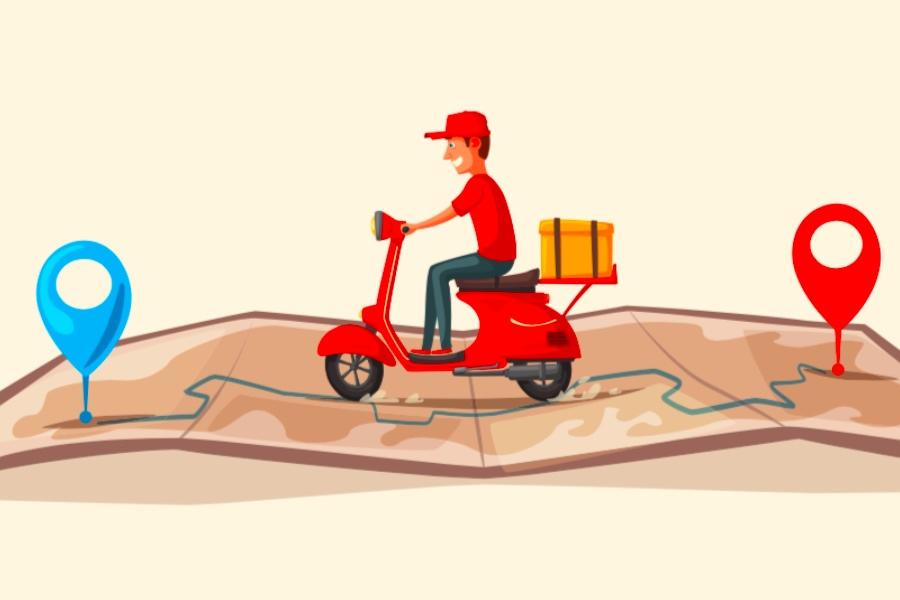
Introduction
Since 2014, China’s express business volume has surpassed developed economies such as the United States, Japan, and Europe, and has become the number one in the world. According to statistics, with an average daily volume of 140 million units, with the busiest day seeing 420 million units delivered in the space of 24 hours.Based on data from 2018, there are about 3 million courier in China and more than 60,000 courier service stations in China. The courier service covers almost 93% of China’s regions, including remote mountainous areas.(People’s Daily Online, 2019)
Development of the express delivery industry
In China, the express delivery industry is a relatively new business unit. In modern form, it has been around for about 30 years. The industry has experienced impressive growth over the past decade due to an increasingly active domestic economy and improved transportation infrastructure.
However, although the Chinese market is quantitatively ahead of other markets, about 90% of parcels circulate within China. No Chinese express company has an independent global logistics network, and most cross-border packages rely on global express giants such as UPS and DHL. These problems indicate that China’s express delivery service does not match the fast-growing express delivery industry, and China’s domestic express delivery companies lack a global industry layout and that China’s express delivery industry has a small international influence. (Chu Daye, 2019)
The impact of digitalization on the express delivery industry
The rapid development of the express delivery industry is closely related to the analysis and processing capabilities of big data. For example, if you want to go to a courier to complete a traditional mail delivery business, the first step is to manually write the address, provided that you ensure the address is valid, because no one can check this address. Secondly, you need to pack the item to prevent it from breaking. Finally, when you send the courier, you can’t know the progress of the delivery. You can’t even guarantee that the courier will reach its destination. With the increase of employee input, the development of digital technology and the rapid expansion of the network, the business scope of express delivery companies have been continuously expanded and improved. New services include door-to-door mail collection, timely delivery, and tracking and inquiry services. Compared to the past, when you send the courier again, most of the work will be done by the machine. You can provide a vague address, and the computer will automatically match the nearest courier station to ensure that the consignee can receive the courier. The machine prints a courier slip with a serial number. On your mobile phone, you can use the serial number to check the courier progress at any time, whether it is delivered accurately, and whether the signatory is accurate.
Timeliness and last-mile delivery are major issues addressed by the courier industry.
One thousand kilometres away from Beijing and Shanghai, if I send a courier at 9 am, how can I ensure that my colleagues in Shanghai will receive it today, traditional delivery companies may only guarantee delivery the next day because the process of centralized redistribution takes a lot of time for distribution. Still, when time generates high economic demand, a new model will also be created. From 8 am to 6 pm, there are 24 flights between Beijing and Shanghai every day For 14 high-speed trains. A courier will pick up the package from your home and send it to the airport or train station within 2 hours. Then your package will arrive in Shanghai with the nearest flight and train. In the hands of the buyer, in just 6 hours, you can complete the express delivery.In this process, the closest courier match, the flight and train match are all the results of using the data based on reasonable use.
“Last mile” delivery is the last step in the whole process that is, the step where the package finally reaches the buyer’s door. Cost and efficiency are the main problems of the last mile (Shelagh, 2018). With the rise of the gig economy, many consumers are already familiar with the concept of local crowdsourcing services through digital platforms such as Uber, Airbnb, and Postmates. Location-based crowdsourcing allows consumers to order coffee from the office and even arrange takeaway delivery when they walk into the apartment. With crowdsourcing technology, retailers, logistics partners and consumers can directly contact local non-professional couriers who use their transportation to deliver goods. Companies can send their online orders to customers faster, and customers can get what they want, when and where they want it. With the continuous improvement and integration of automation in various industries, soon, we may see the distribution of transportation robots to reduce costs.
Possibility of being completely replaced by machines in the express delivery industry
Automation makes postal and courier services, land transportation and food services very vulnerable and replaced by machines (Larry,2018). Imagine the last mile delivery by drone. The whole delivery process is operated by a mobile phone. When the autonomous driving solves the transportation process, the automated express delivery industry may not be very far away.
Conclusion
The development of the express delivery industry is inseparable from the Internet and the Internet of Things. China relies on the number of express delivery to take the lead in the world, but from the perspective of international development, Chinese companies still have a long way to go. Digital management makes the express delivery business two core problem has been effectively solved, new distribution business models are constantly innovating and changing, and the behavior of enterprises using data to make profits also changes as business models change.
Reference
· Chu Daye. (2019). Experts call for global Chinese courier, Global Times Published. Retrieved from http://www.globaltimes.cn/content/1162612.shtml
· Hongyu. (2019).China’s annual volume of express delivery ranks first in the world for five consecutive years. Retrieved from 2019 from http://en.people.cn/n3/2019/0415/c90000-9566709.html
Larry,E. (2018). Workers at risk as robots set to replace 66m jobs, warns OECD, THE GUARDIAN. Retrieved from https://www.theguardian.com/business/2018/apr/03/robots-could-take-over-more-than-65m-jobs-warns-oecd-report
· Shelagh,D. (2018).The challenges of last mile delivery logistics & the technology solutions cutting costs, BUSINESS INSIDER. Retrieved from https://www.businessinsider.com/last-mile-delivery-shipping-explained?r=US&IR=T
 Miya‘s blog
This article from the specific figures introduced, readers can see the specific trend of rapid industry change, with China’s express delivery industry as the main representative. At the same time, it pointed out that Chinese courier companies have independent global logistics networks, but most foreign cross-border packages rely on global express. On the other hand, the author also pointed out that timeliness and last-mile delivery in the digital economy era are the main problems solved by the express delivery industry, and put forward the development trend of express delivery. I appreciate all these points. However, I think the author mainly focuses on the development situation of the express delivery industry in recent years and the convenience brought to human life. It does not clearly show the changes in the development of the express delivery industry in the digital economy, which is somewhat lacking.
LikeLike
Hello miya! Your blog is great! With the rapid development of online shopping, the express delivery industry has also emerged. The network makes picking up and receiving more convenient and fast, but there are still some minor problems. For example, in many cities in China, packages will be put into the smart courier cabinet in the community, which enables self-service pickup and collection, and greatly improves efficiency. However, this is not easy for the elderly in China, because the verification code of the receipt is often composed of English. Many elderly people will find it difficult to collect the packages even if they can use their mobile phones to query logistics information and receive messages. This makes it impossible for machines to completely replace labor. For another example, in China, people always refer to the ‘Jiangsu, Zhejiang and Shanghai charge no delivery fee’. However, in some remote areas, the express delivery cost is very high, and the cost performance is very low. Many courier companies even refuse to deliver to remote areas, such as Tibet and Xinjiang. Digitization has not brought the same convenience to these regions. These are the areas where the express industry needs to optimize and improve. What do you think?
LikeLike