
Reflecting on the digital business model

I’m so glad I took the course and completed it. This blog will firstly give a brief overview of the course and how I felt about participating in the course, secondly I would like to share what I have learnt through the course, and lastly how the course has affected me.

First, The course content and my feelings.

Unlike previous face-to-face courses, this course is a combination of an online course and an offline group seminar. On the positive side, a course like this gives us more freedom in our time. but it also means that we need to be more motivated ourselves. The assessment of the course is divided into several stages, all of which are published in the blog, it’s also a creative way of doing it, and just for me, I haven’t finished blogging before. The new course approach and test content is a learning as well as a challenge for me.

Second, What content did I get?

By reading other people’s blogs, this course allowed me to break out of the limitations of my own thinking and learn more about different industries in digital business. Digital business is changing not only in terms of business models, but also in terms of education, healthcare, transportation, urban development, etc.

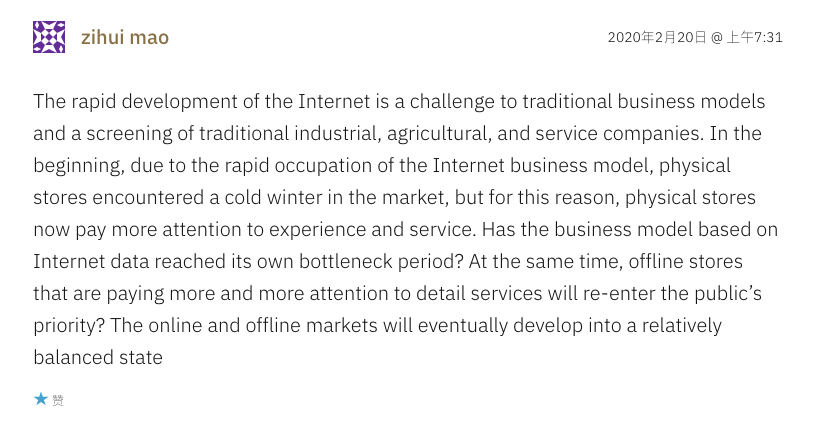
Traditional industries are under enormous pressure in the face of digital commerce, which is forcing traditional industries to change their sales models, with competition between the physical and online stores becoming more intense.(Chengxi,2020)
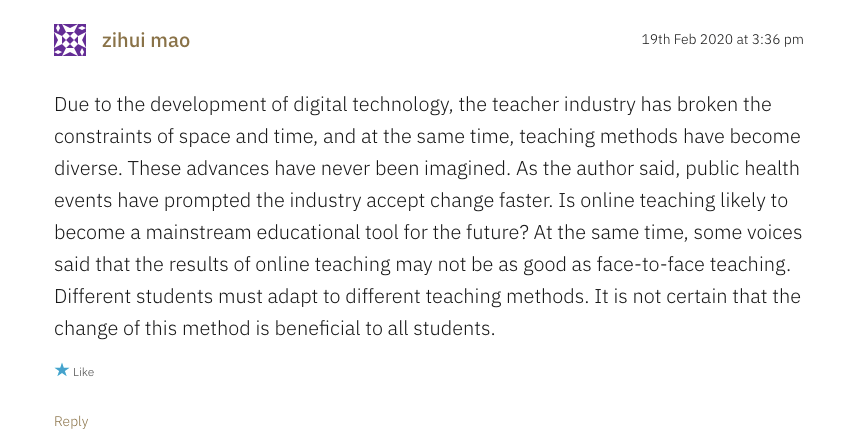
The development of digital technology has also expanded the opportunities for the education industry, using virtual reality to increase the content of the subject, including the recent rapid development of online teaching due to the COVID-19 virus, which has been expropriated worldwide.(Xiyao, 2020)
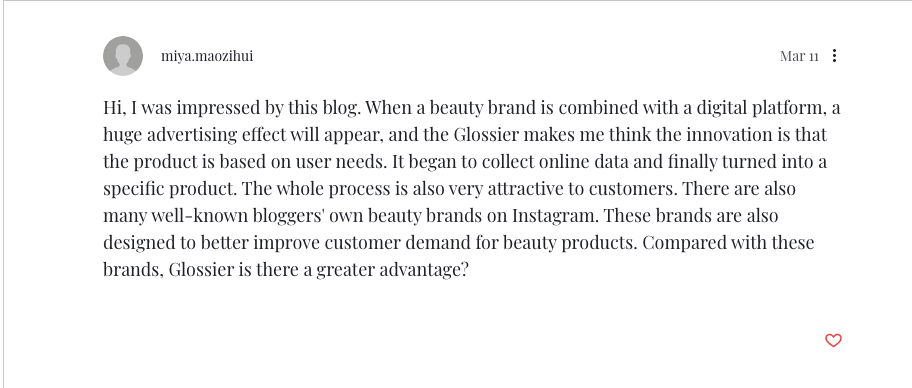
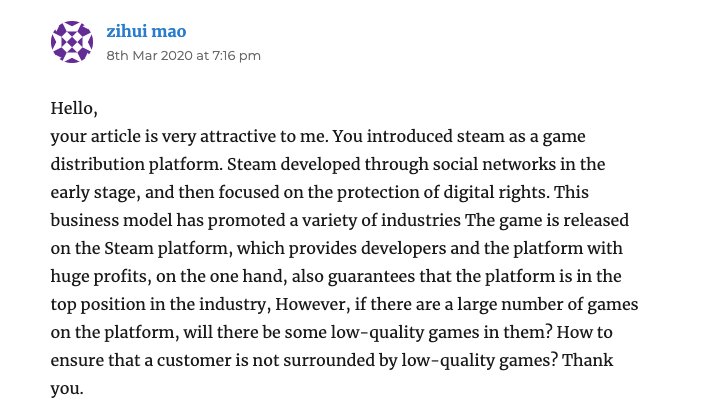
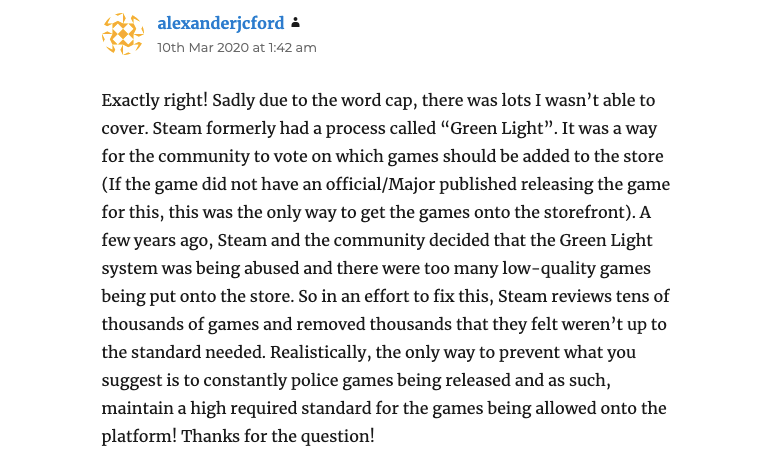
The rise of the sharing and circular economy also shows that digital business is changing our lives more profoundly, with new corporate profitability models and marketing tools emerging , such as those mentioned by Hannah(2020) in his blog ‘Their digital business model is part of an extension practice whereby Glossier have used their digital platform to enable a new type of online business that interacts with customers,their digital presence lets them float the boundaries of the traditional beauty market. They have created a community through platforms that enable customers to interact with one another.’ At the same time Alexander(2020) in his blog also introduces the purely digital business extended by gaming platforms, which makes us think more about the boundaries of the platform and the limits of ethical factors, the innovation of business models always has infinite vitality, we also have to keep consolidating new models to make them more mature and stable for the consumer market.
Last, The impact of this course on me.

This little video is my review of my own blog and a few points that need improvement.

Make it myself.

Just as theory needs to be integrated with practice, when we need to consider our future career plans in the third week of the course, these business model developments and changes are no longer just words, but become new careers, or new career skills, created by the new model. For the future, we are constantly influenced and surrounded by the digital economy, how to discover our own abilities and create our own value is also a process of self-discovery.

Thanks for reading.

Reference

Chengxi.N, (2020), Changes in sales in the digital economy. https://cn356.food.blog/2020/02/17/changes-in-sales-in-the-digital-economy/.

Xiyao. Z, (2020), The impact of digital economy development on the profession of teachers. https://xydigital.business.blog/2020/02/09/the-impact-of-digital-economy-development-on-the-profession-of-teachers/amp/

Hannah, C. (2020), ‘We’, Glossier. https://hlc229.wixsite.com/hannahcookson/post/a-unicorn-born-from-the-digital-ashes.

Alexander, F. (2020), Valve: The Steam digital distribution platform, and their Domination of the online game sales market. https://gamesmarketing.business.blog/2020/03/06/valve-the-steam-digital-distribution-platform-and-their-domination-of-the-online-game-sales-market/


Pinduoduo— China’s new force in e-commerce

With the rise of Alibaba’s global reputation, the development of China’s e-commerce has also attracted more and more attention. But “Pinduoduo” as the latest e-commerce power has been ignored by many people. This company, established in September 2015, is the newest-growing e-commerce startup in Chinese history. Total sales value of 100 million US dollars, which is a milestone reached by Alibaba and JD.com in 5 and 10 years. Today, Pinduoduo’s market value of more than 40 billion US dollars is equivalent to JD.com. In addition, 366 million monthly users and 536 annual active buyers are China’s second largest buyer after Alibaba.

Pinduoduo Is Fast Becoming a Formidable Rival to Alibaba
https://www.youtube.com/watch?v=t92L4Co7-_s

In order to better understand why the “Pinduoduo” business model has achieved successful results, analyze it from the following three perspectives: First, positioning. Second, operating model, and third, profit model.

Positioning

The first point of platform positioning is that Pinduoduo is different from Alibaba’s B2B business model. Instead, it focuses on the C2B business model and allows more customers to buy goods through group purchase at low prices. For customer positioning, the basic users of Pinduoduo are concentrated in third-tier cities. Customers with average income levels, compared with customers in first-tier cities, because these people have less disposable money due to income gaps, so ‘Pinduoduo’ Low prices also attract these customers. (Kirk,2019)

The e-commerce platforms represented by Taobao and Jingdong have two prominent problems in their continuous development:
First, the customer acquisition cost of e-commerce platforms is getting higher and higher; Secondly, due to the ever-expanding categories of services, users are lost in the search and selection of a large number of products to a certain extent, and the purchase decision time is extended.
Today, the time that users stay in the APP is getting shorter and shorter, it is the key to minimize the user’s unnecessary operations and continuously guide users to generate unconscious operations. Don’t let users think and make choices. Let them follow your process naturally.

Operating model

The second point is about the operating model. The core idea is the combination of social networks and e-commerce. For example, the original price of a piece of clothing was £ 20, which can be purchased by £ 5 through grouping. The user can send the product link of the group to a friend. If the group is unsuccessful, the product will be returned. Many people in QQ or WeChat groups (similar to the Facebook messenger group) publish links with ‘Pinduoduo’ group purchase, enabling them to achieve fissionable growth through social networks. In this model, anyone can organize group purchases and encourage friends to buy together. The user has a strong sense of participation. At the same time, this model also solves the problem of trust in product quality. Because it is recommended by friends from around you in real life, the product is easy to get the user ’s favor. Pinduoduo further incentivizes social sharing and bulk purchases by rewarding loyal users with free products, cash, and other perks. This often creates “viral” effects that drive up purchasing activity. From the seller’s perspective, unlike Alibaba sellers, Pinduoduo is more willing to invite manufacturers in the supply chain. The company’s bulk sales model can easily create huge orders for sellers and leave them more space for a price reduction.(Emma,2018)

How Pinduoduo Works,
https://www.youtube.com/watch?v=Zbskb0KMBUU

Profit model

Finally about the profit model, The reason why Pinduoduo’s rapid growth also comes from the low prices of supply chain sellers. Because there are no intermediate dealers, the price will be lower than the market price. At the same time, the group purchase initiators and participants can also profit from it, as long as others Join the group purchase through your link, and the corresponding link sharers can get a rebate. The above is the profit of customers, but for the platform itself, advertising, user traffic data and investment financing are still the main profit methods.

Evaluation and questions

From the very beginning, the group used the capital obtained from financing to subsidize merchants to sell at low prices to attract users. However, free is not a business model. When the platform stops subsidizing merchants, the platform still needs low prices, but the sellers in order to maintain gross profit. , So often use defective products instead. Pinduoduo lacks systematic management and cannot guarantee product quality.

Relying on WeChat and a large number of frequent advertisements, it is almost a booming growth of users and merchants. In fact, low prices attract traffic. Low prices lead to low seller profits, low profits lead to the proliferation of defective products, and then lead to user loss and platform reputation worse. Therefore, the entire platform is labeled as low-cost and dumping, and the platform’s supervision plan will likely cause the contradiction between “businessmen and platforms”,

It takes a long-term consideration of the balance between price and quality, how to design healthier and more scientific operating rules, quality control systems and reward- punishment systems, so as to improve the quality of products and services, optimize the user experience, are the most important issues for Pinduoduo.

Reference

· Emma,L. (2018). The incredible rise of Pinduoduo, China’s newest force in e-commerce.[Weblog]. Retrieved from https://techcrunch.com/2018/07/26/the-incredible-rise-of-pinduoduo/

· Kirk,E. (2019). How Pinduoduo Became the #2 eCommerce Marketplace in China.[Weblog]. Retrieved from https://www.applicoinc.com/blog/how-pinduoduo-became-the-2-ecommerce-marketplace-in-china/

· YouTube. (2018, June 28). Top searches on YouTube: Pinduoduo Is Fast Becoming a Formidable Rival to Alibaba. Retrieved from https://www.youtube.com/watch?v=t92L4Co7-_s

· YouTube. (2018, July 29). Top searches on YouTube: How Pinduoduo (PDD) Works. Retrieved fromhttps://www.youtube.com/watch?v=Zbskb0KMBUU

Express industry accompanies rapid development of digital economy

Introduction

Since 2014, China’s express business volume has surpassed developed economies such as the United States, Japan, and Europe, and has become the number one in the world. According to statistics, with an average daily volume of 140 million units, with the busiest day seeing 420 million units delivered in the space of 24 hours.Based on data from 2018, there are about 3 million courier in China and more than 60,000 courier service stations in China. The courier service covers almost 93% of China’s regions, including remote mountainous areas.(People’s Daily Online, 2019)

Development of the express delivery industry

In China, the express delivery industry is a relatively new business unit. In modern form, it has been around for about 30 years. The industry has experienced impressive growth over the past decade due to an increasingly active domestic economy and improved transportation infrastructure.

However, although the Chinese market is quantitatively ahead of other markets, about 90% of parcels circulate within China. No Chinese express company has an independent global logistics network, and most cross-border packages rely on global express giants such as UPS and DHL. These problems indicate that China’s express delivery service does not match the fast-growing express delivery industry, and China’s domestic express delivery companies lack a global industry layout and that China’s express delivery industry has a small international influence. (Chu Daye, 2019)

The impact of digitalization on the express delivery industry

The rapid development of the express delivery industry is closely related to the analysis and processing capabilities of big data. For example, if you want to go to a courier to complete a traditional mail delivery business, the first step is to manually write the address, provided that you ensure the address is valid, because no one can check this address. Secondly, you need to pack the item to prevent it from breaking. Finally, when you send the courier, you can’t know the progress of the delivery. You can’t even guarantee that the courier will reach its destination. With the increase of employee input, the development of digital technology and the rapid expansion of the network, the business scope of express delivery companies have been continuously expanded and improved. New services include door-to-door mail collection, timely delivery, and tracking and inquiry services. Compared to the past, when you send the courier again, most of the work will be done by the machine. You can provide a vague address, and the computer will automatically match the nearest courier station to ensure that the consignee can receive the courier. The machine prints a courier slip with a serial number. On your mobile phone, you can use the serial number to check the courier progress at any time, whether it is delivered accurately, and whether the signatory is accurate.

Timeliness and last-mile delivery are major issues addressed by the courier industry.

One thousand kilometres away from Beijing and Shanghai, if I send a courier at 9 am, how can I ensure that my colleagues in Shanghai will receive it today, traditional delivery companies may only guarantee delivery the next day because the process of centralized redistribution takes a lot of time for distribution. Still, when time generates high economic demand, a new model will also be created. From 8 am to 6 pm, there are 24 flights between Beijing and Shanghai every day For 14 high-speed trains. A courier will pick up the package from your home and send it to the airport or train station within 2 hours. Then your package will arrive in Shanghai with the nearest flight and train. In the hands of the buyer, in just 6 hours, you can complete the express delivery.In this process, the closest courier match, the flight and train match are all the results of using the data based on reasonable use.

“Last mile” delivery is the last step in the whole process that is, the step where the package finally reaches the buyer’s door. Cost and efficiency are the main problems of the last mile (Shelagh, 2018). With the rise of the gig economy, many consumers are already familiar with the concept of local crowdsourcing services through digital platforms such as Uber, Airbnb, and Postmates. Location-based crowdsourcing allows consumers to order coffee from the office and even arrange takeaway delivery when they walk into the apartment. With crowdsourcing technology, retailers, logistics partners and consumers can directly contact local non-professional couriers who use their transportation to deliver goods. Companies can send their online orders to customers faster, and customers can get what they want, when and where they want it. With the continuous improvement and integration of automation in various industries, soon, we may see the distribution of transportation robots to reduce costs.

Possibility of being completely replaced by machines in the express delivery industry

Automation makes postal and courier services, land transportation and food services very vulnerable and replaced by machines (Larry,2018). Imagine the last mile delivery by drone. The whole delivery process is operated by a mobile phone. When the autonomous driving solves the transportation process, the automated express delivery industry may not be very far away.

Conclusion

The development of the express delivery industry is inseparable from the Internet and the Internet of Things. China relies on the number of express delivery to take the lead in the world, but from the perspective of international development, Chinese companies still have a long way to go. Digital management makes the express delivery business two core problem has been effectively solved, new distribution business models are constantly innovating and changing, and the behavior of enterprises using data to make profits also changes as business models change.

Reference

· Chu Daye. (2019). Experts call for global Chinese courier, Global Times Published. Retrieved from http://www.globaltimes.cn/content/1162612.shtml

· Hongyu. (2019).China’s annual volume of express delivery ranks first in the world for five consecutive years. Retrieved from 2019 from http://en.people.cn/n3/2019/0415/c90000-9566709.html

Larry,E. (2018). Workers at risk as robots set to replace 66m jobs, warns OECD, THE GUARDIAN. Retrieved from https://www.theguardian.com/business/2018/apr/03/robots-could-take-over-more-than-65m-jobs-warns-oecd-report

· Shelagh,D. (2018).The challenges of last mile delivery logistics & the technology solutions cutting costs, BUSINESS INSIDER. Retrieved from https://www.businessinsider.com/last-mile-delivery-shipping-explained?r=US&IR=T

Design a site like this with WordPress.com
Get started